-
Unlike my parents, I was raised in a world with smartphone technology at my fingertips, punching in business names and home addresses into my GPS before I even got my driver’s license. From an early age, I attempted to dazzle my parents with my phone’s infinite knowledge and the GPS abilities of its internal map, but they resisted, insisting that I shouldn’t rely on such a tool to get around. Like many young people, I didn’t listen to this advice and grew dependent on my GPS, not just to get around, but also to know what to expect.
-
 via memesandmoodz
 -
While it’s important to hone a keen sense of direction without needing a GPS, setting routes on a modern mapping app does more than guide you from Point A to Point B. They both show you how to get somewhere, and predict accidents, slowdowns, speed limit changes, construction, objects in the road, and even alternate routes in the event of closure. I swear I’m not sponsored by any GPS system!
-
Without this early warning system, drivers can be stuck in mercurial traffic, caught off guard, and can potentially endanger people around them. The GPS signifies preparedness and prevention, not a dwindling sense of orienteering skills. Although it may be contributing to navigational illiteracy, the GPS makes for better, more prepared drivers. Which driver is safer on the road: the one who knows how to get to the mall by heart or someone aware of the lane closure next to the school zone on their way to the mall?
-
-
Re-Inventing the Wheel
Most people are not cartographers nor are they orienteering specialists, and many modern folks couldn’t read a topographical, physical map to save their lives. Lucky for us, pretty much everyone nowadays has a smartphone in their pocket, which is a nifty multitool that serves as a permalink to the internet, a directionally accurate compass, and a detailed, multilevel map of the entire globe.
-
This technological marvel defines an era that 15th-century Portuguese explorers could never imagine. An era where everything revolves around a pocket-sized global positioning system. Behold! The era of the GPS.
-
-
According to Diana Furchtgott-Roth, a Forbes journalist, GPS is crucial to how we navigate, communicate, and interact with others. She says, “[GPS] changed not only transportation but also agriculture, construction, emergency response, and precise timing for financial transactions and communications networks.” GPS tech is so deeply ingrained in every level of society that it’s tough to imagine our modern world without it. Location services exist on every app, location-specific customization is hardwired at every level of technological advancement.
-
Would you like to turn on location services? It’s a little creepy to admit, but our phones are tracking us, and they know exactly where we are at all times; there’s no fighting that fact unless you want to chuck your cell in the Hudson River.
-
With that in mind, users might as well reap the expert benefits that come alongside location services. Namely, GPS navigation. As long as you’re not fiddling with your in-dash GPS while driving, navigation apps can be a safe and helpful tool on the road.
-
Although young people are reported to be more directionally challenged than their 45-year-old+ predecessors, younger generations are also more skilled at integrating useful smart tools into their daily habits. Oftentimes, young people put the GPS on before they drive, not just to navigate where they are going, but to predict the duration of their drive, foresee accidents along the way, and to have the peace of mind of knowing what lies ahead.
-
Although it’s a flex to say that you know how to get somewhere without the help of a GPS, isn’t it more important to share your exact ETA and avoid any potential dangers on the road?
-
via scooby
-
Safety First
There’s merit to both sides of the GPS navigation argument.
While the older generations have a natural sense of direction ingrained in their upbringing, young drivers are better adept to collect as much information about their trajectory as possible before departing. Both instinct and preparedness are worthy traits for a safe driver.However, ultimately, on the road where there are an infinite number of factors to consider at any given moment, overpreparedness can make the difference between life or d3ath. It doesn’t really matter if you know how to get where you’re going by heart if you’re unaware that a refrigerator was dumped in the fast lane on your route. It’s going to be a potentially life threatening surprise when traffic comes to a screeching halt for no apparent reason. A GPS would have warned you…
-
The tool that can predict unwanted surprises literally sits in our back pocket, why not use it to stay safe on the road?
Being GPS dependent doesn’t mean you are a bad driver, it just means you’re a tech-reliant navigator, a phone-charger-obsessed chauffeur, and, most importantly, an overprepared motorist on the road, and that’s nothing to be ashamed of.
Why GPS Dependency Makes You a Safer Driver
Do you know how to use a map? Not a pre-printed MapQuest route, but a real, paper-backed, pirate-style map. It's okay to admit you don't…
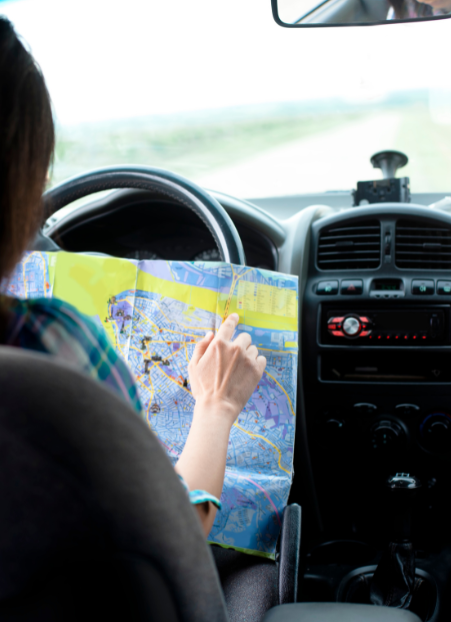
As a millennial, I never heard the end of my mom's generation's (the boomers) pride about being directionally savvy, remembering the street name of their childhood best friend, and the verbal directions to their favorite corner store with eerie accuracy. The technology of their age explains this skillset. Throughout their lives, boomer drivers had an atlas stowed away in their 1979 Ford Pinto alongside archaic roadmaps with yellowing pages and crinkled up edges. If the boomer generation wanted to drive somewhere, they had to either recall directions from memory or decipher the lines and squiggles of a physical map.
However, it's not exactly road safe to whip out a 4ft map, a compass, and a protractor at the nearest red light when you're feeling lost.